
“We Are in Tombs”

The ERC condemns the explosion in Turkey and mourns the families of the victims
October 10, 2016
Dr Maha Azzam at a “Stop Egypt’s executions” press conference
October 10, 2016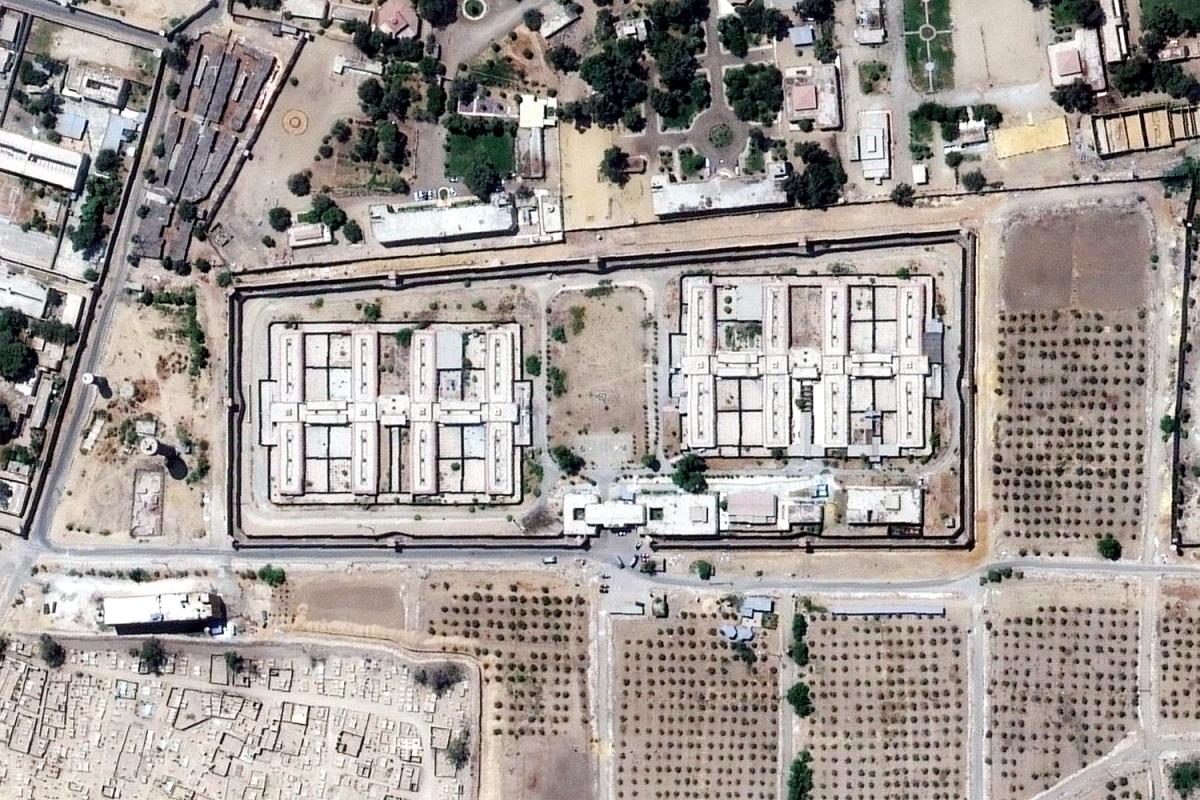
Summary
“It was designed so that those who go in don’t come out again unless dead. It was designed for political prisoners.”
–Ibrahim Abd al-Ghaffar, former warden, during a television interview in 2012
Since July 2013, when Egypt’s military, led by Defense Minister Abdel Fattah al-Sisi, overthrew Mohamed Morsy, the country’s first freely elected leader and a high-ranking Muslim Brotherhood member, the Egyptian authorities have engaged in a widespread campaign of arrests targeting a broad spectrum of political opponents.
Between Morsy’s overthrow and May 2014, Egyptian authorities arrested or charged at least 41,000 people, according to one documented count, and 26,000 more may have been arrested since the beginning of 2015, lawyers and human rights researchers say. The government itself has admitted to making nearly 34,000 arrests.
This influx of detainees strained Egypt’s detention system. According to the semi-official National Council for Human Rights, prisons operated at 150 percent of their capacity in 2015. Over the two years that followed Morsy’s fall, the Egyptian government built or made plans to build eight new prisons.
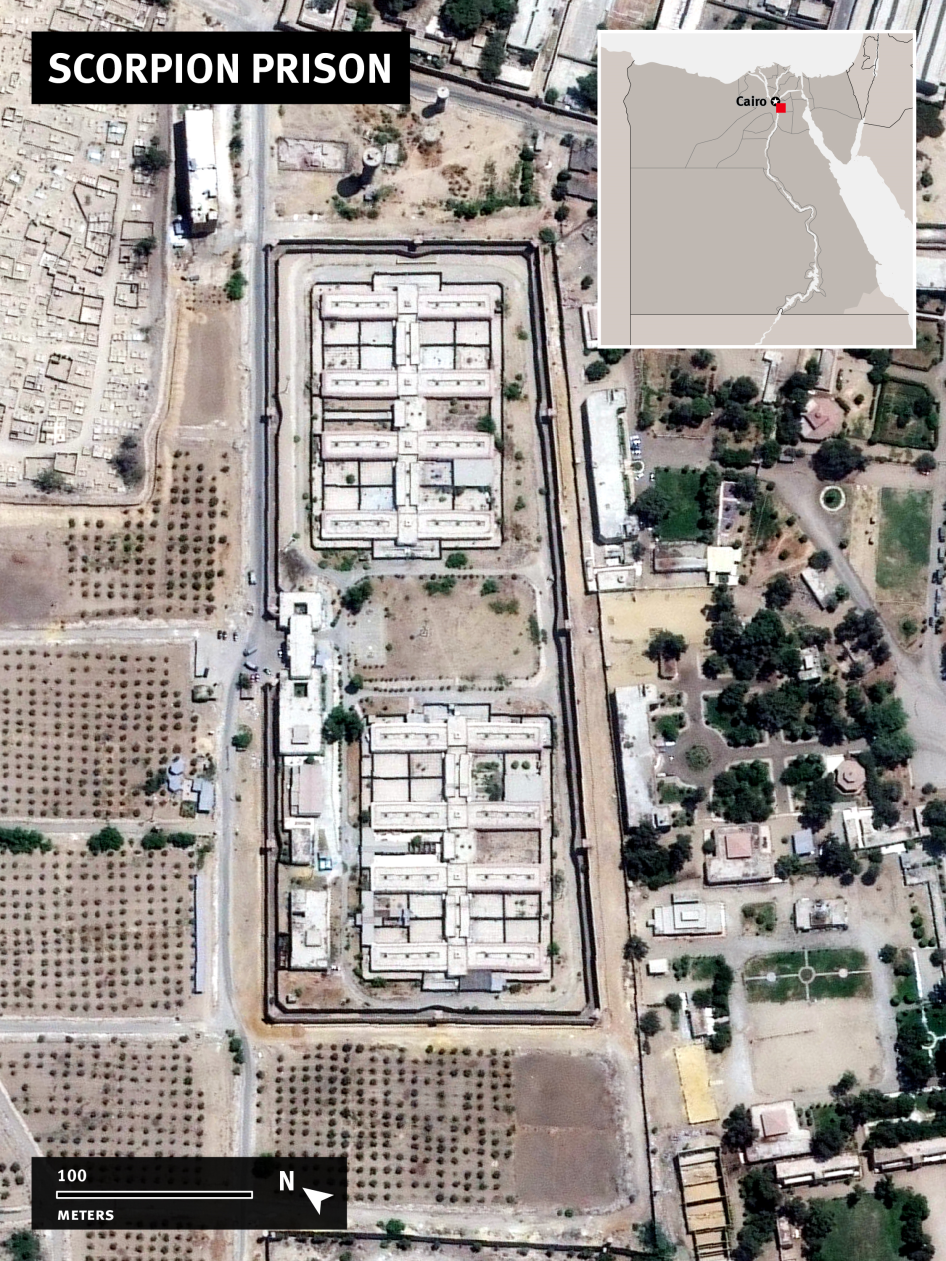
One was readymade. Built in 1993 and officially named Tora Maximum Security Prison, its reputation had long ago earned it a different moniker: the Scorpion.
This report, based on 23 interviews with relatives of inmates, lawyers, and a former prisoner, documents abusive conditions in Scorpion. Authorities there have banned inmates from contacting their families or lawyers for months at a time, held them in degrading conditions without beds, mattresses, or basic hygienic items, humiliated, beaten, and confined them for weeks in cramped “discipline” cells – treatment that probably amounted to torture in some cases – and interfered with their medical care in ways that may have contributed to some of their deaths. The near total lack of independent oversight in Scorpion, documented in this report, has exacerbated these abuses and contributed to impunity.
Though detainees have alleged serious abuses at a number of prisons, many of which hold political prisoners – such as Borg al-Arab in Alexandria, where Morsy is confined – Scorpion has re-emerged as the central site for those deemed enemies of the state, a designation that now includes the Muslim Brotherhood, al-Sisi’s primary political opposition.
Built amid one of the country’s most violent internal conflicts, Scorpion has for most of its history been used to hold those viewed as Egypt’s most dangerous prisoners, including alleged members of al-Gama`a al-Islamiyya(the Islamic Group) and Egyptian Islamic Jihad, both of which participated in a widespread extremist insurgency in the 1980s and 1990s that targeted foreigners and the Egyptian government and left hundreds dead. Among Scorpion’s prisoners were those accused of taking part in the assassinations of President Anwar al-Sadat in 1981 and speaker of parliament Rifaat al-Mahgoub in 1990.
By the 2000s, this conflict had ebbed, and the authorities released thousands who had been held for years without trial. But after 2013, Scorpion returned to its old role.
Set within the Tora Prisons Area, a government compound on the Nile River at the southern edge of Cairo, Scorpion sits at the end of the state’s repressive pipeline, overseen at nearly all points by the Interior Ministry and its internal security service, the National Security Agency (Qata` al-Amn al-Watani). In scores of cases documented by Human Rights Watch, those deemed opponents of the government are investigated and arrested by National Security agents, tortured into confessions by those agents during periods of forced disappearance that can last for weeks or months, and then put on trial while being held, in near isolation without meaningful access to a lawyer, in prisons where National Security officers hold sway.
Relatives believe that Scorpion’s four “H-blocks,” containing 320 cells, currently hold around 1,000 prisoners, including most of the top leadership of the Muslim Brotherhood, who are imprisoned alongside alleged members of the extremist group Islamic State, also known as ISIS. Some of those held in Scorpion are not members of any Islamist movement, such as the journalist Hisham Gaafar and the activist doctor Ahmed Said.
While the Egyptian authorities generally try to prevent unsanctioned information about prisons from reaching the public, they go to even greater lengths at Scorpion. Visits with relatives and lawyers are irregular, banned for long periods, and last for just a few minutes. Inmates are not allowed to give interviews or communicate with people outside in any way. On rare occasions during court hearings, they are allowed to speak briefly in the presence of the media. Only a few of those sent to Scorpion since 2013 have been released. Human Rights Watch was aware of only one released prisoner who has spoken about his experience publicly: Al Jazeera correspondent Abdullah al-Shamy, who was held there for one month in 2014. Many inmates have been handed multiple long sentences by criminal courts and remain detained pending appeals that typically last for years. Others are held in pretrial detention, often on a variety of serious charges, without consideration of bail.
Though Scorpion, like all prisons in Egypt, falls under the administration of the Interior Ministry’s Prisons Authority Sector, in practice the National Security Agency maintains almost total control. This arrangement, which has been the case since Scorpion’s inception, when the agency was known as State Security Investigations (Mabahith Amn al-Dawla), means that Egypt’s primary internal security agency, with its long record of torture and other abuses, is responsible not only for the investigation and arrest of suspects, but also for their treatment during incarceration.
Visit Bans
Scorpion lies behind a veil of secrecy that both permits and exacerbates abuse. Interior Ministry authorities maintain this secrecy primarily by regularly and arbitrarily banning visits to the prison by both family members and lawyers. From roughly March to August 2015, the Interior Ministry banned all visits to Scorpion. The ban started almost immediately after al-Sisi appointed Egypt’s current interior minister, Magdy Abd al-Ghaffar. All of the relatives interviewed by Human Rights Watch agreed that conditions in Scorpion deteriorated dramatically after al-Ghaffar’s March 2015 appointment.
The visit ban prevented families from delivering food, medicine, and clothes that were either unavailable or in meager supply inside the prison, which some relatives called a “starvation” policy. Some said their family members lost 29 to 34 kilograms (65 to 75 pounds) of weight. At least six Scorpion inmates died in custody during or soon after this lockdown period (see below). The ban prevented some family members from visiting relatives on death row who were executed without notice, violating Egyptian law.
Though the Interior Ministry lifted the blanket visit ban in August 2015, the authorities continue to regularly and arbitrarily deny visits, whether by relatives or lawyers, and to limit their length to around five to ten minutes. To do so, they rely on a vaguely worded article of Egypt’s prisons law, unchanged since 1956, which allows visits “to be restricted or completely banned due to conditions at certain times for reasons of health or related to security.”
Lawyers, when allowed to visit, are restricted to seeing their clients in the office of the prison’s warden or chief of investigations. A guard or prison official sits in the same room at every meeting and does not allow either lawyer or inmate to have paper or a writing instrument. These restrictions leave prisoners unable to prepare their legal defense and violate their right to a fair trial. The authorities have arrested and forcibly disappeared at least one lawyer, Mohamed Sadek, who won several court victories on behalf of Scorpion inmates’ relatives, according to his colleagues.
Poor Prisons Conditions
Scorpion authorities do not allow inmates to possess basic necessities for comfort and hygiene, including soap, shampoo, combs, toothbrushes, toothpaste, shaving kits, plates, eating utensils, or other items such as watches, books, prayer rugs, and paper or writing instruments. Newspapers and books, except school books in some cases, are forbidden.
The denial of basic necessities for hygiene has caused or exacerbated afflictions like skin rashes and infections and left inmates unable to maintain their usual physical appearance.
According to relatives, cells in Scorpion do not contain beds. Instead, inmates sleep on low concrete platforms. Most relatives said that their family members have never had mattresses and rely on two or three blankets provided by the prison or flattened cardboard boxes for cushioning. One family told Human Rights Watch that their relative had a mattress in his cell, and three said that their family members had mattresses in the past but that prison authorities confiscated them.
The authorities’ denial of basic items of comfort and hygiene amounts, under international norms for treating prisoners, to degrading treatment apparently intended to humiliate them.
Interference with Medical Treatment
Interior Ministry officials regularly interfere with Scorpion inmates’ medical treatment. During periods when visits are banned, they forbid relatives from delivering medicine that is unavailable in the prison pharmacy. Even when visits are allowed, guards sometimes arbitrarily seize medication, stripping pills out of their packaging and throwing some away or mixing pills in a bag, meaning that oftentimes not all of the medicine will be delivered to the pharmacy, relatives said.
National Security and Prisons Authority officers have denied requests by prisoners to be taken outside Scorpion for medical care – even when such requests were endorsed by prosecutors – and have flouted doctors’ instructions by returning prisoners to Scorpion before their treatment finished, several families said. Scorpion authorities almost never tell relatives when inmates fall ill or are transferred to outside clinics or hospitals.
There is no hospital inside Scorpion, and all of the relatives interviewed by Human Rights Watch agreed that inmates do not receive regular visits from a prison doctor, as mandated by Egyptian law. This denial of care has left Scorpion inmates suffering from serious medical problems – including diabetes, Hepatitis C, epilepsy and heart disease – without regular access to their prescribed medicine or specialist treatment. Prisoners with chronic or advanced illnesses are particularly vulnerable in such an environment.
Deaths in Custody
At least six Scorpion inmates died in custody during or soon after the period in 2015 when all visits were banned. Relatives and lawyers of three of the six inmates told Human Rights Watch that the authorities had refused to consider conditionally releasing them on medical grounds, prevented them from receiving timely treatment, and failed to seriously investigate their deaths. In one case, prosecutors withheld a burial permission form until a relative of the deceased inmate promised not to file a complaint about the lack of medical care.
Essam Derbala, a leader of the Islamic Group who had previously been held for two decades in the Tora prison complex and who had diabetes, was not allowed to receive his medicine despite appearing at an August 2015 court hearing shaking and unable to stand or control his own urination. He died following the hearing, after prison officials refused to supply him with medicine delivered by his family, despite prosecutorial and judicial orders to do so, according to his brother.
Another inmate, Farid Ismail – a former member of parliament for the Muslim Brotherhood’s Freedom and Justice Party – died in May 2015 around a week after falling into a hepatic coma in his cell in Scorpion and being transferred to an outside hospital. Khairat al-Shater, a deputy supreme guide of the Muslim Brotherhood who is held in Scorpion, told his daughter, Aisha al-Shater, that prison officers had ignored inmates’ pleas to help Ismail.
Al-Shater’s daughter told Human Rights Watch that during the period when Ismail died, authorities did not allow inmates to leave their cells, so her father and others arranged a system to check on each other’s health by knocking on their cell doors or shouting. On the day of Ismail’s death, Ismail did not reply to the roll call, and they assumed that he was sleeping or had not heard. Later that night, when they asked the guards to check on Ismail, the guards told them it was “none of their business.” The following day, after they had still not heard from Ismail, they caused a commotion, and the guards eventually came and removed Ismail – who was unconscious – from his cell.
“Afterward, even calling to each other is prohibited,” Aisha al-Shater said. “So right now, they say, ‘We are in tombs. We’re living, but we are in tombs.’”
Physical and Mental Abuse and Hunger Strikes
The poor conditions in Scorpion led some detainees to begin a hunger strike in February 2016, and by the following month, at least 57 inmates had joined, according to an inmate’s relative. Government authorities, including Major General Hassan al-Sohagi, the assistant interior minister for prisons, responded by threatening some of the hunger striking inmates with violence, while others were beaten. By August 2016, only a few prisoners continued to strike, according to the relative.
Officers severely beat one hunger-striking inmate who, according to a doctor the family consulted, was likely suffering from epilepsy. The beating left him severely injured and necessitated treatment in a prison hospital, his brother and another relative said. Authorities heavily sedated him and another hunger striker without their consent, after which the second man lost consciousness for around a day and a half and vomited blood.
Al-Shamy, the Al Jazeera correspondent, spent his month of imprisonment in Scorpion on a hunger strike. He told Human Rights Watch that officers twice tried to end his strike by force-feeding him and sedated him without his consent during one of those attempts.
Scorpion authorities have beaten and humiliated inmates and held them for weeks at a time in small cells in a “discipline wing” that lack electricity, running water, or a toilet, restricting those held in such cells to an even more limited diet than the general prison population. Prisoners and their family members claimed that this treatment was meant to punish and intimidate them.
Mohamed al-Beltagy, a high-ranking Muslim Brotherhood member and former member of parliament, claimed in an August 2016 court hearing that Major General al-Sohagi and another high-ranking Interior Ministry officer forced him during a recent cell inspection to strip and squat while they filmed him in order to force him to withdraw a complaint against President al-Sisi. Aisha al-Shater said her father has told her that inmates have been made to lie on the ground while officers take pictures and “stomp” on their stomachs.
Lack of Oversight
Though Egyptian law gives several agencies power to inspect prisons, in practice, independent authorities rarely exercise oversight. This is not a new problem. In a 1993 report that followed visits to six prisons in Egypt, Human Rights Watch identified the Interior Ministry’s control over prisons as a key factor underlying abuse.
The Law on the Organization of Prisons, issued by President Gamal Abdel Nasser in November 1956 and still in effect, though amended many times, gives Interior Ministry inspectors, governors, judges, and prosecutors the right to inspect prisons. Human Rights Watch was aware of only one occasion – the case of al-Shamy, which involved unusually high international attention – when any group empowered to inspect prisons exercised that oversight power in Scorpion.
The government funded National Council for Human Rights has visited Scorpion three times, but only after securing permission from the authorities and without the ability to meet inmates in private. A coalition of Scorpion families criticized the council after its most thorough visit to the prison, in August 2015, saying that it had whitewashed the abuse occurring inside.
The inability or lack of will to exercise oversight in Scorpion prevents prisoners from making complaints about their treatment and fosters an environment of impunity for abuse.
International Standards
The international norms regarding prison conditions are set out in the United Nations Standard Minimum Rules for the Treatment of Prisoners, which were updated and renamed the “Nelson Mandela Rules” by the UN General Assembly in December 2015. The first Mandela rule states that all prisoners “shall be treated with the respect due to their inherent dignity and value as human beings. No prisoner shall be subjected to, and all prisoners shall be protected from, torture and other cruel, inhuman or degrading treatment or punishment, for which no circumstances whatsoever may be invoked as a justification.”
Under international law and the Mandela Rules, the authorities’ physical abuse and prolonged use of “discipline” cells qualify as cruel and inhuman treatment and probably amount to torture in some cases. Their interference in medical treatment and force-feeding of at least one hunger-striking inmate also constituted cruel and inhuman treatment, and in the case of inmates who died in custody, might have violated their right to life.
Human Rights Watch calls on Egyptian authorities to take a number of immediate and longer-term steps to improve conditions in Scorpion and allow greater supervision of prisons countrywide.
The Egyptian Interior Ministry should immediately implement critical changes at Scorpion, and any other Egyptian prison where similar abuses take place, in order to bring its prisons into compliance with both Egyptian and international law. These should include: ending arbitrary visit bans; ensuring that prisoners have regular access to doctors and appropriate medical treatment; and providing them with the minimum of daily necessities for hygiene and comfort.
The Egyptian government should allow independent international detention monitors to visit Scorpion Prison. The government should also form an independent national committee composed of doctors, human rights lawyers, independent human rights groups, current and former judges and prosecutors, and others and give the committee the authority and mandate to make unannounced prison visits, meet with prisoners privately, submit complaints for investigation to a special prosecutor, and prepare legislation to improve prison conditions. The government should also invite the African Commission on Human and Peoples’ Rights (ACHPR) to visit Egypt to assess the human rights situation and grant the ACHPR access to Scorpion and other detention facilities. The African Union High-Level Panel for Egypt recommended such a visit in its final report in 2014.
The Egyptian public prosecution should investigate and if appropriate charge those with command responsibility for Scorpion Prison in connection with the possible acts of torture and cruel and inhuman treatment committed by guards and officials. Prosecutors should exercise their lawful oversight powers by making inspection visits to Scorpion and other prisons, taking prisoner complaints for investigation, and prosecuting officials when there is evidence of abuse.
Finally, the Egyptian parliament should ratify the UN’s Optional Protocol to the Convention against Torture and other Cruel, Inhuman or Degrading Treatment or Punishment, which requires both state and international monitoring of detention sites in order to prevent abuse. Parliament should also amend the country’s prisons law to eliminate the overly broad justification for visit bans, limit the use of solitary confinement, and mandate prosecutorial visits to prisons.
Human Rights Watch sent detailed inquiries regarding conditions and policies at Scorpion Prison to the Interior Ministry and Prosecutor General’s Office on August 12, 2016, and copied the Ministry of Foreign Affairs. At the time this report was being prepared for publication in mid-September, there had been no response to these letters.
Source: www.hrw.org
